To Be The Best Grey Board Supply Chain In The World


Introduction
When you are sourcing sturdy, premium paper substrates for photo albums, photo frames and high-end hardcover publications, black cardboard stands out as one of the most reliable and cost-effective choices in the paper packaging and printing industry. Many buyers, including photo studio suppliers, frame manufacturers, printing houses and book binders, keep black cardboard as a core raw material for their finished products. Unlike ordinary grey board or white cardboard, black cardboard features consistent deep black color on one or two sides, good stiffness, solid density, smooth surface and excellent dimensional stability. These unique physical properties make it perfectly matched for photo album inner pages, photo frame backing support and hardcover book cover lining.
In this article, we will walk you through the core characteristics of quality black cardboard, break down its practical advantages for photo albums, photo frame back panels and hardcover art book covers, and share key purchasing tips for overseas importers and manufacturers. If you are looking for a dependable paper board supplier for photo and printing finished goods, this guide will help you understand why black cardboard remains a top selection in this niche market.
What Is Black Cardboard?
Black cardboard is a high-density solid paper board, dyed black during the pulping process or surface-coated with uniform black color. It can be single-sided black or double-sided black, with different thickness options ranging from 0.8mm up to 3mm and above. The base pulp is tightly pressed, so the board does not easily bend, warp or deform under normal indoor storage conditions.
A common misunderstanding among new buyers is that black cardboard is just grey board sprayed with black paint. Premium-grade black cardboard uses through-dye technology, which means the inner core is also black, not only the surface. This avoids the problem of white or grey edges showing after cutting, die-cutting or trimming. This feature is extremely important for photo albums and exposed frame backing boards, where clean edges directly affect the finished visual quality.
Key basic properties of commercial black cardboard:
• High rigidity and bending resistance
• Uniform black color, low color difference between batches
• Flat sheet surface, no pits or bubbles
• Good die-cutting, creasing and binding performance
• Low moisture expansion rate
• Recyclable and eco-friendly pulp options available
Black Cardboard for Photo Albums
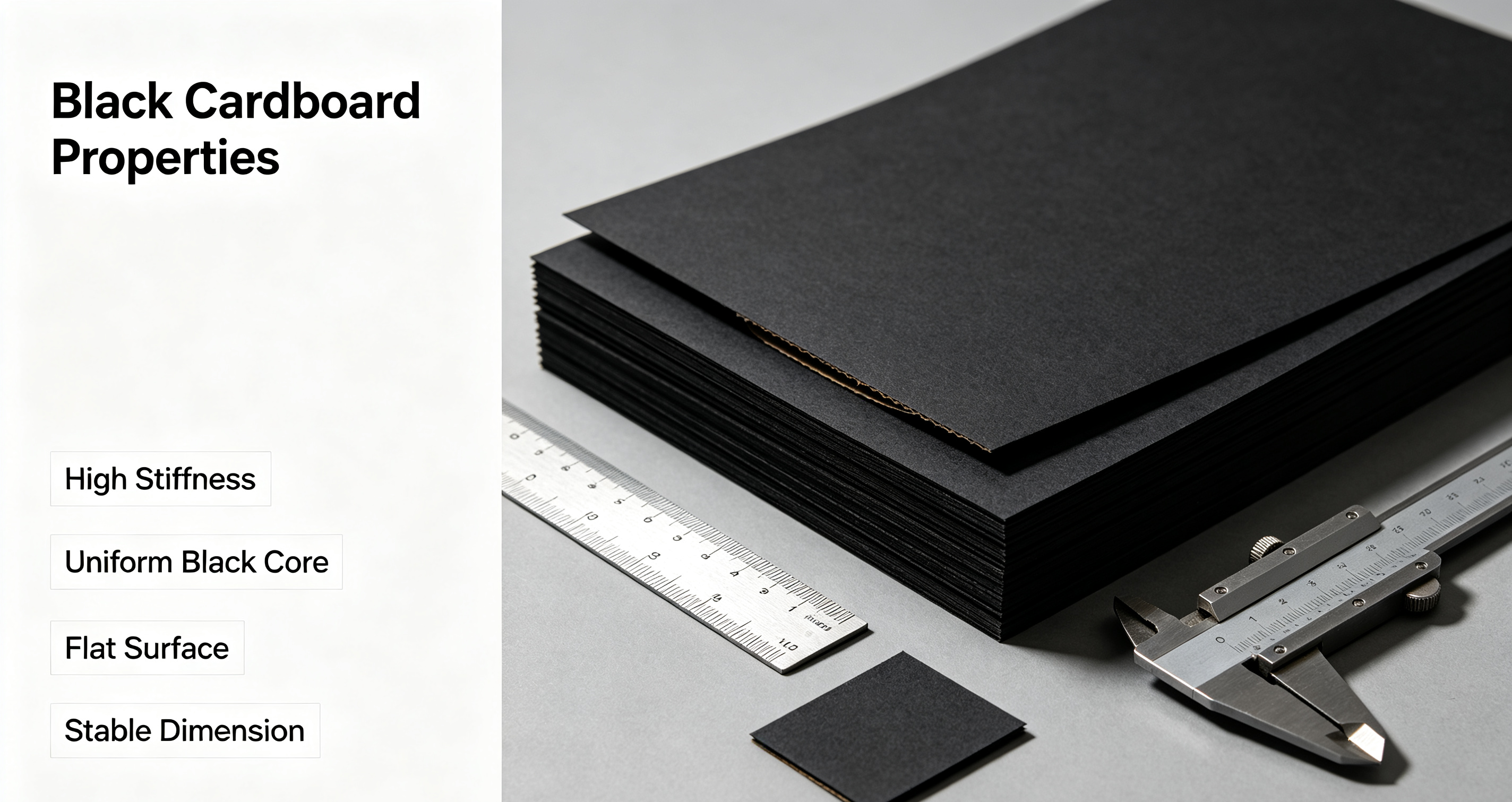
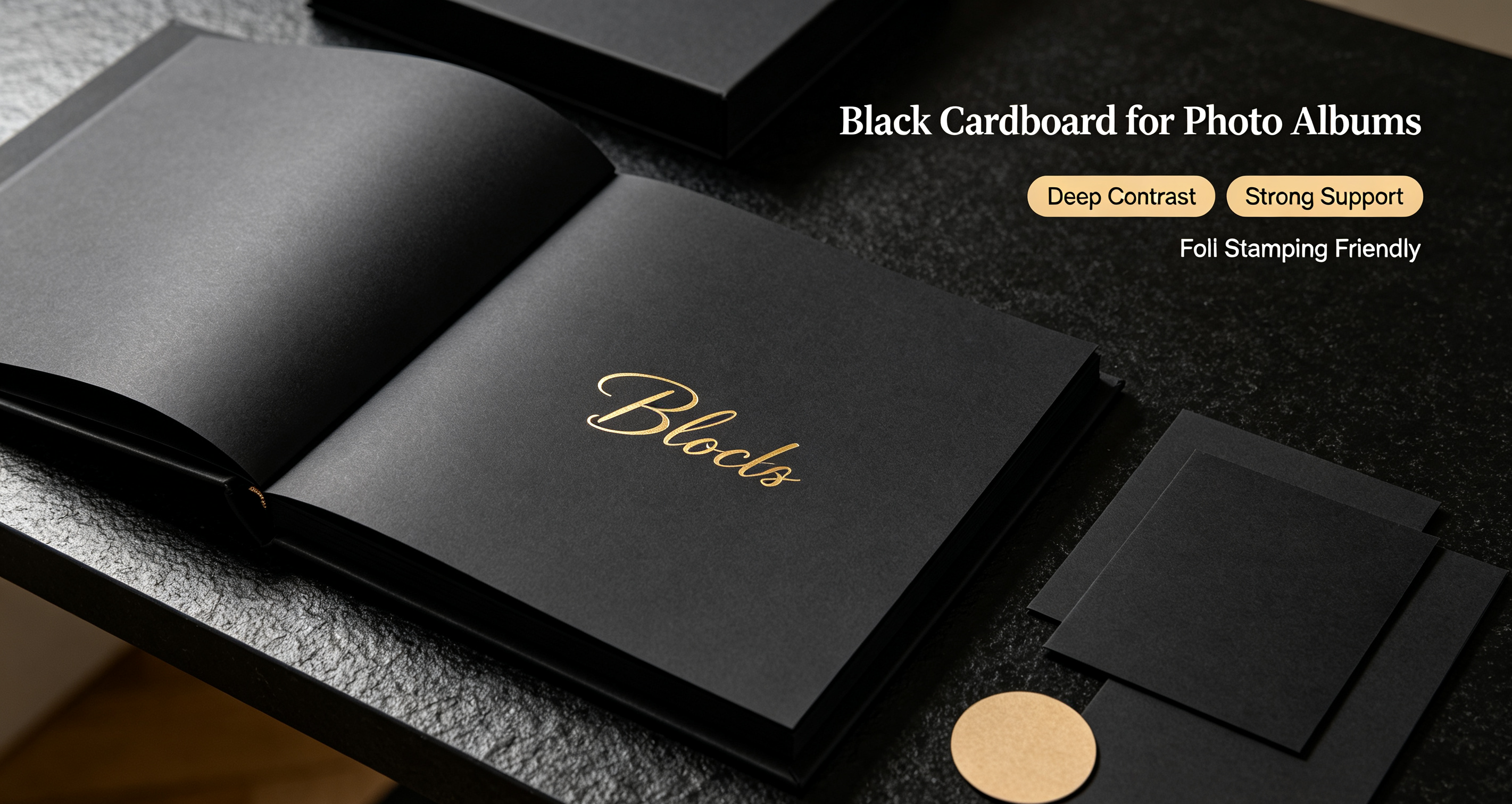
Photo albums require a backing material that can hold photos, photo sleeves and printed pages flat for years. Thin paper will curl; cheap low-density board will bend after glue lamination. Black cardboard solves these pain points perfectly.
First, the deep black background creates a strong contrast. When photos, portrait prints or art images are mounted on black cardboard pages, the colors and details of the picture pop out much better than on white or grey substrates. This is the main reason wedding photo albums, portrait albums and art photography albums widely adopt black cardboard inner sheets.
Second, its stiffness supports heavy photo layers. Many luxury albums use thick photo paper, laminated films and multiple glued layers. The black cardboard core keeps the whole album flat, prevents page sagging, and maintains the album shape after repeated opening and closing. Double-sided black cardboard is preferred for multi-page albums, as both sides can be used for photo mounting without unsightly exposed base color.
Third, processing adaptability is excellent. Factories can crease, cut, round corners, hot-stamp and UV print directly on black cardboard album pages. Gold, silver or colored foil stamping looks very elegant on the black surface, which is popular for custom wedding albums, family memory albums and commercial portfolio albums.
Common album applications: wedding photo albums, portrait photo books, artist portfolio albums, baby memory albums, travel photo albums, custom souvenir albums.
Black Cardboard for Photo Frame Backing Boards
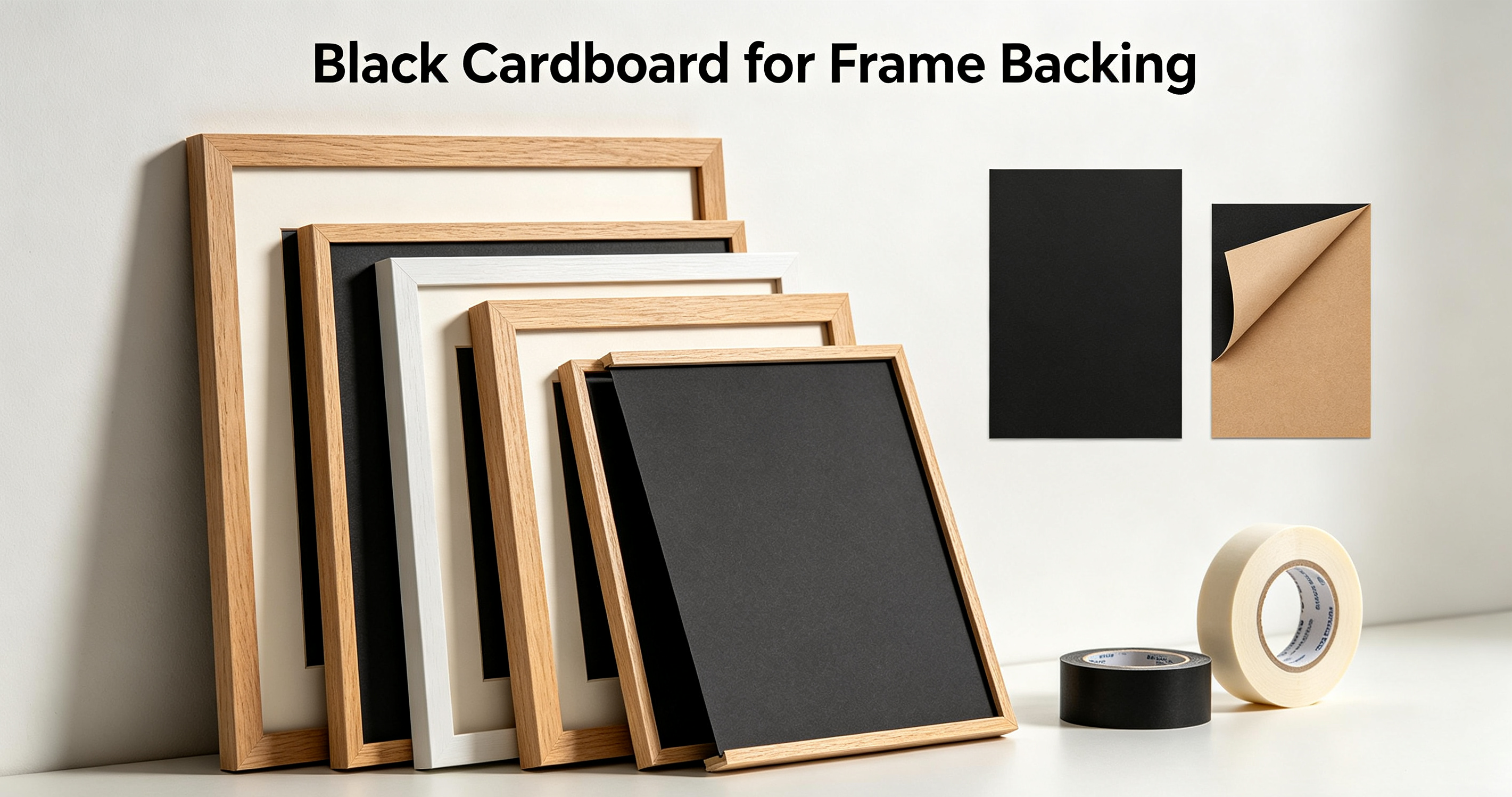
The backing board is an invisible but critical component of every photo frame. It holds the photo, mat board and glass in place, keeps the frame rigid, and prevents warping over time. Many frame manufacturers choose black cardboard instead of ordinary grey board for mid-to-high-end frames.
The biggest advantage is edge consistency. When the backing board is slightly visible from the frame gap, a neat black edge looks far more premium than a rough grey edge. Double-sided black cardboard works well for reversible frames, where customers can swap the photo and flip the backing.
Stability is another core benefit. Photo frames are usually hung on walls for long-term display. Low-quality board will absorb moisture, bend and push against the glass, which may damage the photo. Good black cardboard has stable moisture resistance, maintaining flatness in normal indoor humidity.
It also works well with adhesive and tape. It bonds smoothly with double-sided tape, photo mounting adhesive and acid-free glue. Acid-free black cardboard is available for archival-grade frames, ideal for limited-edition prints, vintage artworks and collectible photos, because acid-free material slows down photo yellowing and aging.
Typical frame scenarios: portrait photo frames, art print frames, poster frames, gallery display frames, custom souvenir frames.
Black Cardboard for Hardcover Album & Art Book Covers
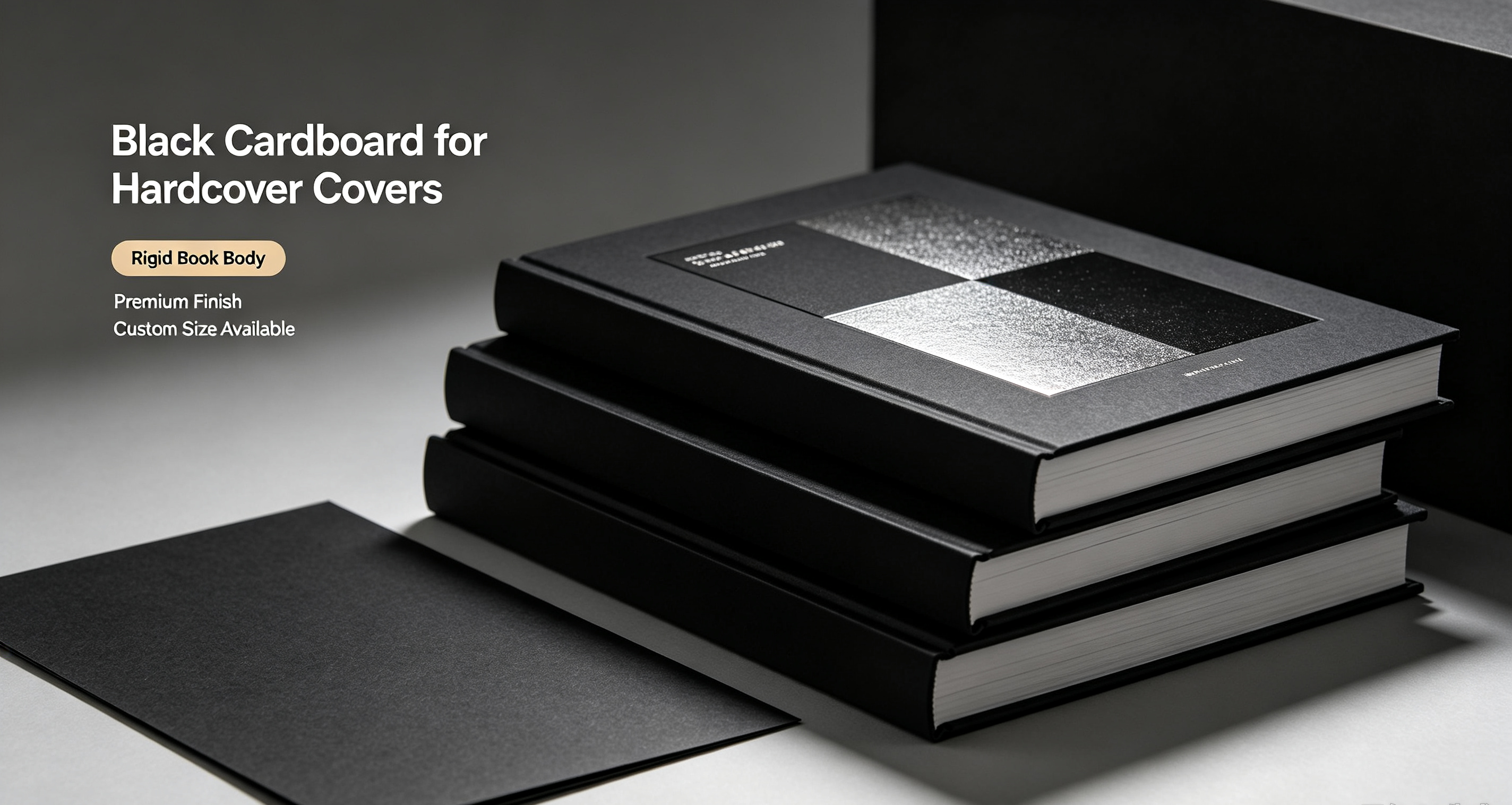
Hardcover books, art catalogues, picture books and exhibition catalogues need a solid cover substrate. Black cardboard is widely used as the inner board of hardcover shells, and sometimes directly as the exposed cover material for minimalist high-end publications.
For hardcover binding, the board needs to withstand repeated opening force. Black cardboard’s high stiffness protects the book block, prevents the cover from collapsing, and gives the book a heavy, luxurious hand feel. Many art books, photography monographs, fashion catalogues and museum exhibition books use black cardboard as the cover base.
When wrapped with art paper, fabric or PU leather, black cardboard provides a stable base. If the design is minimalist without extra wrapping, raw black cardboard with debossing, foil stamping or screen printing creates a sleek, premium look. This style is popular for brand catalogues, designer portfolios and limited-edition books.
Book binders also value its cutting performance. Clean, straight cuts reduce post-processing work, and batch color consistency ensures all books in one order look uniform.
Core Advantages of Black Cardboard for This Category
1. Superior visual presentation: Deep black background enhances photographs and artwork, creating a high-end, minimalist aesthetic.
2. Outstanding rigidity and flatness: Resists bending and warping for long-term display and storage.
3. Clean cutting performance: Through-dyed board avoids ugly grey cut edges.
4. Versatile finishing support: Suitable for hot stamping, debossing, UV printing, lamination and gluing.
5. Multiple thickness options: Flexible for thin photo album pages and thick heavy-duty frame backing.
6. Eco-friendly options: Recyclable pulp and FSC-certified black cardboard are available for buyers with sustainability requirements.
7. Stable batch quality: Suitable for mass production by printing factories, frame workshops and album manufacturers.
Tips for Overseas Buyers When Sourcing Black Cardboard
• Confirm single-sided black or double-sided black according to your finished product. Photo albums usually prefer double-sided black; simple frame backing can use single-sided to save cost.
• Check whether you need acid-free grade. Acid-free is necessary for archival photos and collectible art prints.
• Clarify thickness and GSM. Thicker board delivers stronger stiffness but higher shipping weight.
• Ask for color sample swatches first. Black has many tones: jet black, soft black, matte black. Match the color to your brand standard.
• Verify moisture content. High moisture content will lead to warping after arrival at your warehouse.
• Confirm certifications such as FSC, REACH if your market is Europe, USA, Australia or other regulated regions.
Conclusion
Photo albums, photo frame backing panels and hardcover art books are product lines that attach great importance to texture, flatness and visual effect. Black cardboard perfectly matches these requirements, combining solid physical support with elegant dark aesthetics. It is not just a simple backing material; it elevates the perceived quality of the final photo and printing products.
Whether you are an album manufacturer, frame supplier, printing house or distributor serving gift, home decor and art markets, black cardboard is a reliable substrate worth adding to your product list. If you need custom sizes, special thickness or certified eco-friendly black cardboard, work with a professional paper board manufacturer that can control color consistency and flatness for large orders.